
Do VPNs Keep Logs of My Activity?
Explore whether VPNs keep logs of your online activity. Understand the implications of VPN logs and how they affect your privacy. Learn if VPNs track activity and what it means for your security.
11/2/20252 min read
If you’re using a VPN to stay anonymous online, one question matters more than any other:
“Do VPNs keep logs of what I do?”
The short answer? Not the good ones!
Reputable VPNs like NordVPN, Surfshark, and PureVPN operate under strict no-logs policies, meaning they never record or store your browsing history, connection timestamps, IP addresses, or data traffic.
But not all VPNs are created equal and understanding how “no-logs” really works is essential for protecting your privacy.
What “No-Logs” really means?
A no-logs policy (or zero-logs policy) means your VPN provider does not monitor, collect, or store any identifiable user data.
That includes:
No browsing history
No IP addresses or session details
No connection timestamps
No files downloaded or websites visited
In other words, even if someone demanded data from your VPN provider. There’d be nothing to hand over.
However, some VPNs advertise “no-logs” but still collect minimal metadata for maintenance or analytics. That’s why verified audits are the gold standard for trust.
Many leading VPNs have undergone independent audits to prove their no-logs claims are real, not just marketing talk.
Here are examples of trusted audited VPNs:
Why a No-Logs policy matters?
Every time you connect to the internet, your data leaves a digital trail. ISPs, advertisers, and even governments can track what you do online — unless your VPN truly keeps no logs.
A verified no-logs VPN ensures:
True anonymity — your activity can’t be traced back to you
Protection from data requests — even legal demands can’t expose your data
Freedom online — browse without fear of profiling or censorship
Simply put, a VPN without a real no-logs policy isn’t a privacy tool — it’s a liability.
Best No-Logs VPNs
After years of testing and reviewing VPNs, these are the most reliable no-logs providers you can trust with your privacy:
NordVPN: Independently audited, based in Panama (no data-retention laws).
Surfshark: Verified no-logs policy, headquartered in the privacy-friendly Netherlands.
PureVPN: Now independently audited, with strong transparency practices.
All three combine military-grade encryption, leak protection, and jurisdiction outside surveillance alliances (like Five Eyes) ensuring your online activity remains your business only.
👉 Learn the best ecryption for your IOS, Android and Microsoft devices
How to verify a VPN’s No-Logs claim yourself?
So, do VPNs keep logs?
Some do. But the top-tier ones don’t just promise privacy — they prove it.
VPNs like NordVPN, Surfshark, and PureVPN have undergone independent audits to confirm their zero-logs policies are legitimate, not marketing fluff.
If privacy is your priority, choose a verified no-logs VPN — and you’ll have total confidence that your online activities stay private, encrypted, and untraceable.
Related guides
The importance of independent audits
Before subscribing to any VPN, check:
Their privacy policy – It should clearly state what data (if any) is collected.
Audit results – Look for third-party verification by Deloitte, PwC, or KPMG.
Jurisdiction – Avoid VPNs based in countries with mandatory data retention laws.
Reputation – Search for transparency reports or past controversies.
If a VPN isn’t open about these, it’s a red flag.
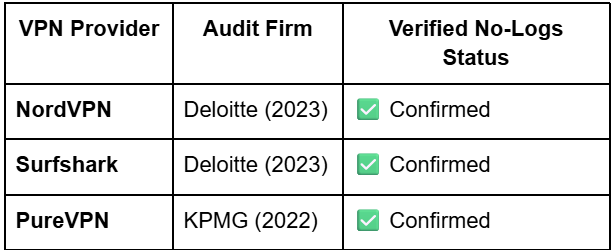
These audits are performed by external cybersecurity firms that review the VPN’s infrastructure, data handling, and logging practices.
Pro Tip: Always look for a VPN with publicly available audit reports. That’s the real sign of transparency and credibility